Sustainability
Environmental Sustainability
Environmental Sustainability
1. Climate Change Management
Smothong Group Public Company Limited and its subsidiaries are committed to managing and adapting to the impacts of climate change. The Company has implemented various initiatives and projects in alignment with its climate change management strategy, including organizational greenhouse gas (GHG) emissions management and the adoption of renewable energy projects, such as solar energy, to reduce carbon emissions and enhance environmental sustainability.
Energy Consumption
Non-renewable energy represents 3.01% of the Company's total energy consumption, while renewable energy accounts for96.99%. Renewable energy utilized by the Group is derived from three primary sources: biomass,biogas, and solar energy, representing 85.63%, 0.01%, and14.36%, respectively. The Company's continued investment in renewable energy reflects its commitment to improving energy efficiency, reducing dependence on fossil fuels, lowering greenhouse gas (GHG) emissions, and supporting the transition toward a low-carbon economy in line with its long-term sustainability objectives.
| Goals | Strategies | 2025 Performance Results |
|---|---|---|
| Maintain non-renewable energy consumption at no more than 5%. | Install renewable energy electricity generation systems. | Non-renewable energy consumption was 3.01%. |
Solar Energy Project
The Company recognizes the importance of utilizing solar energy as part of its commitment to sustainable energy management. Solar rooftop systems have been installed at the roofs of the Company's Head Office, Tha Chana Branch, and Saraburi Branch. As a clean and renewable energy source, solar power helps reduce greenhouse gas (GHG) emissions associated with fossil fuel-based electricity generation. In 2025, the Company generated and consumed a total of80,910 kWh (291,276 MJ) of electricity from its solar photovoltaic (PV) systems. Electricity generated from solar energy accounted for1.40% of the Company's total electricity consumption compared with electricity purchased from theProvincial Electricity Authority (PEA). As a result, the Company reduced its greenhouse gas emissions by38,432.25 kgCO₂e per year.
Greenhouse Gas Inventory
The Company and its subsidiaries have been certified for the Carbon Footprint for Organization (CFO) by theThailand Greenhouse Gas Management Organization (Public Organization) (TGO). The certification coversScope 1, Scope 2, and Scope 3 greenhouse gas emissions under the Operational Control approach.
Direct and Indirect Greenhouse Gas (GHG) Emissions (Scope 1, Scope 2, and Scope 3)
| Branch | Unit | Scope 1 | Scope 2 | Scope 3 | GHG Emission Intensity (TonCO₂e/ton Product) | Ozone Depleting (kgCFC11e) |
|---|---|---|---|---|---|---|
| SMOH, SMO2 | TonCO₂e | 17,968 | 204 | 33,516 | 0.5576 | 0.0000 |
| SMO1 | TonCO₂e | 31,745 | 701 | 29,028 | 0.6444 | 0.9130 |
| SMO4 | TonCO₂e | 4,627 | 561 | 12,081 | 0.6338 | 0.0000 |
| AL Palm | TonCO₂e | 27,370 | 829 | 22,668 | 0.6963 | 0.7480 |
| MGP | TonCO₂e | 8,135 | 195 | 34 | 0.0005 | 1.5400 |
Note: GWP of AR5 is used.
2. Water and Wastewater Management
The Group has its own raw water sources that are sufficient to support its operational requirements. As a result, the Company does not rely on or share natural water resources with surrounding communities. This helps minimize the risk of potential conflicts over water resources while supporting responsible water stewardship and safeguarding the Company's corporate reputation.
| Goals | Strategies | 2025 Performance Results |
|---|---|---|
| Reduce water consumption in the production process. | Recirculate and reuse water from the production process (Reuse). | Recycled water volume: 37 megaliters. |
| Zero incidents of wastewater quality parameters non-compliant with legal standards. | Continuously monitor and develop the wastewater treatment system for maximum efficiency. | The number of non-compliant wastewater quality parameters was 0. |
Water Consumption
Water used in the Company's production processes is sourced entirely from surface water. The Company does not discharge water outside its production facilities, as all water is retained and utilized within the factory premises. In 2025, the total volume of water withdrawn was949 megaliters (ML), which was equal to the total volume of water consumed. The Company's total water consumption intensity across all operating sites was 0.03 megaliters per tonne of product.
Wastewater Management
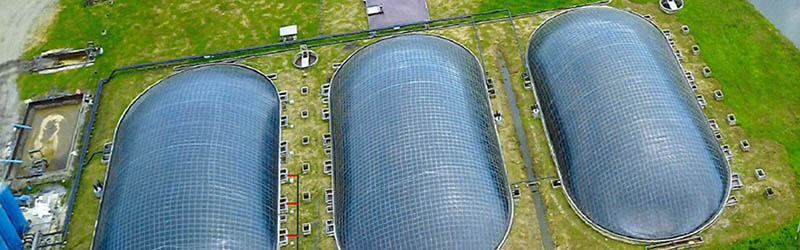
Wastewater generated from the production process is first directed to the Company's biogas system, where it is utilized for biogas production. The remaining wastewater is subsequently treated through the Company's wastewater treatment system. The Company applies wastewater treatment technologies that are appropriate for the characteristics of the wastewater generated in order to achieve maximum treatment efficiency. The treatment process includes astabilization pond system consisting of anaerobic ponds, facultative ponds, andmaturation ponds. Following stabilization, the treated wastewater is further processed through an ozonation system, an advanced wastewater treatment technology that does not generate toxic by-products. This ozonation technology has been implemented at the Company'sPhanom Branch and Tha Chana Branch to enhance wastewater treatment efficiency and support environmentally responsible operations.
Water Recycling Project
The Company has implemented a water recycling initiative by reusing high-quality water generated from its production processes in other operational activities to reduce overall water consumption within its facilities. In 2025, the total volume of water recycled and reused from the production process amounted to 37 megaliters (ML), demonstrating the Company's commitment to efficient water resource management and sustainable operations.
3. Waste and By-product Management
The Company adopts a comprehensive waste management approach under the concept of “Make Waste to the Best Value,” with the objective of maximizing the value and utilization of all materials generated from its operations. During the palm oil extraction process, various by-products are generated. Recognizing the potential value of these by-products, the Company has implemented effective management practices to maximize their utilization. For example, palm fiber is used as biomass fuel in boilers to generate steam, while bottom ash, fly ash, decanter sludge, and wastewater sludge are utilized as soil conditioners for agricultural purposes.
In addition to waste and by-products generated from the production process, the Company also manages waste generated from employees and office activities. The Company places great emphasis on raising employees' awareness and fostering a sense of responsibility for efficient waste management by promoting the 3Rs Principle:
- Reduce: Encourage employees to use electronic documents instead of printed paper to minimize paper consumption.
- Reuse: Implement water recycling projects that reuse water from production processes within the factory and encourage employees to maximize the reuse of paper.
- Recycle: Promote waste segregation through the Company's “Greenlife Zero Waste” initiative, encouraging employees to separate recyclable waste properly. The initiative aims to reduce waste generation, conserve natural resources, minimize environmental impacts, and support the Company's long-term sustainability goals.
Greenlife Zero Waste Initiative
The Greenlife Zero Waste Initiative was established by the Company to promote the proper segregation and recycling of waste generated within the organization. To facilitate effective waste separation, designated recycling bins are strategically placed throughout the Company's facilities and clearly labeled according to waste categories, making it convenient for employees to dispose of and separate recyclable materials correctly. In 2025, the total amount of recyclable waste collected through the initiative was 3,553 kilograms, reflecting the Company's commitment to enhancing resource efficiency, reducing waste sent to landfill, and fostering environmental awareness among employees as part of its long-term sustainability strategy.
4. Air Pollution Management
The Company has implemented highly efficient and internationally recognized air pollution control technologies across its production facilities. One of the key technologies employed is the Electrostatic Precipitator (ESP), which uses electrostatic forces to remove particulate matter from exhaust gases. The ESP system is capable of capturing more than 98% of particulate matter smaller than 1 micron, while maintaining low pressure loss and operating effectively under high-temperature conditions.
To ensure compliance with environmental regulations, the Company continuously monitors stack emissions and ambient air quality from identified air pollution sources in accordance with applicable legal requirements. The key air pollutants monitored include:
- Carbon Monoxide (CO)
- Nitrogen Oxides (NOₓ)
- Sulfur Oxides (SOₓ)
- Particulate Matter (PM₁₀)
- Fine Particulate Matter (PM₂.₅)
Based on air quality monitoring results from all operating sites, all measured values remained within the emission limits prescribed by applicable environmental regulations. In addition, the Company conducts PM₂.₅ and PM₁₀ monitoring in surrounding communities to ensure that its operations do not adversely affect local air quality. This proactive monitoring demonstrates the Company's commitment to enhancing environmental performance, protecting public health, and maintaining the trust and well-being of neighboring communities.